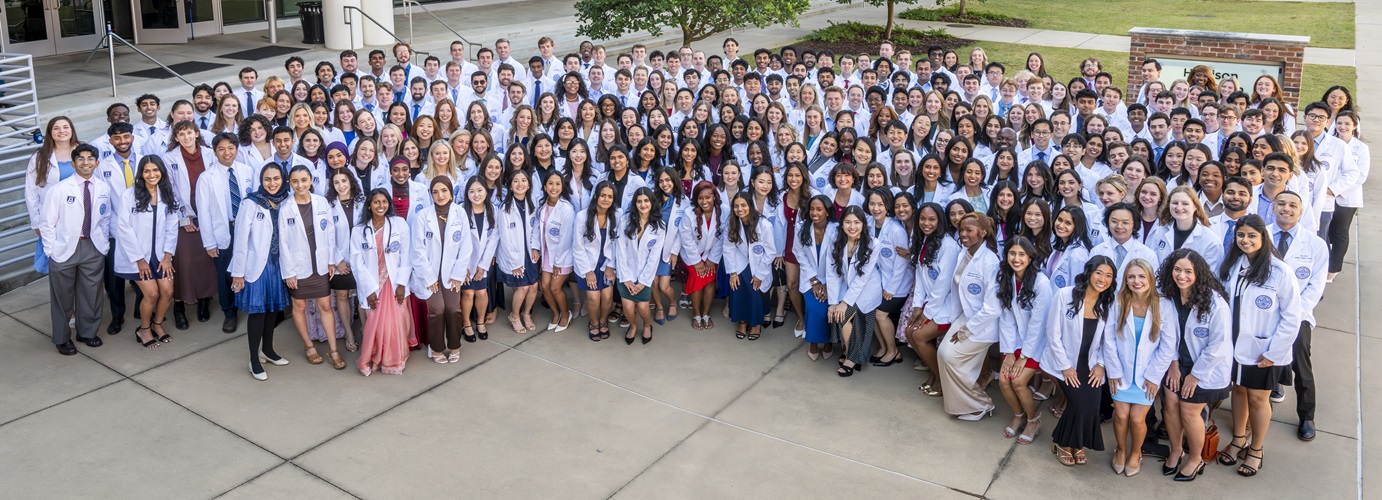
Dear Medical College of Georgia friends,
Expansion of T35 NIH training grant opens up more research opportunities for our students
We’ve talked before in these writings about the important work Drs. Wendy Bollag and Carlos Isales are doing to build the next generation of physicians and scientists interested in aging. They recently received another National Institutes of Health T35 training grant that expands that work in an important way, including, for the first time, an opportunity specifically for our own medical students.
Their original Program for Aging Research in the Summer, or PARIS, gives medical students an immersive summer experience working alongside our aging researchers. But when MCG moved to our accelerated 3+ curriculum, our students no longer had the traditional summer break that made participating possible.
But true to their usual amazing form, Drs. Bollag and Isales found a solution. The new Program for Aging Research in Training Years 2-4, appropriately called PARTY, extends the opportunity into the later years of medical school. Together, PARIS and PARTY will support about 14 to 15 medical students each grant year in eight- to 12-week research experiences.
Fourth-year student Peter-Jon Williams is the first student to join the PARTY
Our first PARTY participant is fourth-year student Peter-Jon Williams, who is spending eight weeks working with Dr. Brian Annex, chair of our Department of Medicine. Peter-Jon met Dr. Annex during a cardiology rotation and was impressed by the way he combined patient care and research.
Their work together focuses on peripheral artery disease, an age-associated condition caused by reduced blood flow, particularly to the legs. Peter-Jon says it’s particularly rewarding that he gets to experience both sides of that work, seeing patients and collecting samples in the clinic, then bringing those samples back to the laboratory to study the biology of the disease. He also told us that having eight dedicated weeks to immerse himself in research has been invaluable – that staying connected to science will make him a better physician, particularly as medicine continues to evolve. I could not agree more.
That is exactly what Drs. Bollag and Isales want to accomplish. Aging research at MCG has grown significantly, and rightly so. By 2034, Americans age 65 and older are projected to outnumber children for the first time in our nation’s history. Programs like PARIS and PARTY allow us to introduce talented medical students to that work early and, hopefully, inspire them to make aging research part of their careers. Peter-Jon is the first MCG student to join the PARTY, but I know that he will be a great ambassador for those who will follow.
MCG students win big at the Georgia Urological Association meeting poster presentations
Our incredible students are just one of the reasons that I remain so confident that the future of medicine is in great hands. Here’s another example. Several recently presented their research at the Georgia Urological Association’s annual meeting, earning recognition while tackling some important issues in urologic care, and bringing home some awards for their poster presentations.
Second-year students Ryan Schumann and Arthur Yu, working with Dr. Vinata Lokeshwar, examined a decade of NIH funding for urological research. They found that while funding increased in absolute dollars, urology’s share of the overall NIH budget actually declined, as did the proportion devoted to supporting early-career investigators.
Their classmate, Shashank Madarapu, took a closer look at prostate cancer treatment among Asian and Pacific Islander men. When those populations were grouped together, there appeared to be little difference in treatment. But when researchers examined the groups individually, they found that Native Hawaiian and Pacific Islander men had 36% higher odds of receiving no definitive treatment for curable prostate cancer, highlighting how important it can be to look beyond broad demographic categories.
Amazing faculty mentors allow our students to ask important research questions early in their careers
Second-year student Tioluwani Olatunji and classmates Siri Jangam, Samay Patel and Ryan Schumann examined another important issue: the changing urology workforce. They found that as more urologists move from private practice into academic and other institutional settings, they are increasingly concentrated in metropolitan areas, doing little to improve the longstanding shortage of urologic care in rural communities.
And one of our fourth-year students, Miki Patel, who is applying for a urology residency this year, presented two case reports from patients encountered during clinical training. One focused on a rare neurological complication associated with kidney cancer, while the other explored the management of a rare pediatric urologic emergency and earned fourth place at the meeting.
It’s so inspiring to see our students asking important questions so early in their careers, from how we fund urologic research and improve access to care to how we address workforce challenges and learn from complex patients. I am also grateful they have incredible faculty mentors, including Drs. Lokeshwar, Martha Terris, Luke Martin, Bradley Morganstern and Zachary Klaassen.
Dr. Jerry Burton Banks appointed program director for St. Joseph’s/Candler MCG Family Medicine Residency
It’s been a little over a year since we announced we were expanding our longtime educational partnership with St. Joseph’s/Candler Health System in Savannah to establish its first graduate medical education programs. The new internal medicine residency, directed by Dr. John Cinicola is slated to accept its first residents next summer, followed by family medicine the following summer, in 2028. The plan is to eventually train 48 residents between the two programs.
We recently took another important step forward. Dr. Jerry Burton Banks II has been appointed as founding program director of the new Family Medicine Residency Program. Dr. Banks brings exactly the kind of experience you want when building a new residency program. For the past decade, he has served as founding program director of the Family Medicine Residency Program at Grand Strand Medical Center in Myrtle Beach, where he led the program through accreditation, recruited faculty and helped develop its curriculum. He also previously led the Family Medicine Residency Program at East Tennessee State University and has spent much of his career teaching medical students and residents.
This partnership addresses something we talk about often: Georgia needs more physicians, and we need more opportunities to train them here. Georgia ranks 40th nationally in residents per capita, and we know that where physicians complete their residency training plays an important role in where they ultimately choose to practice.
Dr. M. Peyton Fanning joins the Internal Medicine Residency Program as associate director
We also recently welcomed Dr. M. Peyton Fanning as associate program director of the St. Joseph’s/Candler Internal Medicine Residency Program. His appointment is something of a homecoming. Dr. Fanning earned his medical degree from Mercer University School of Medicine in Savannah before serving seven years on active duty in the U.S. Navy, where he built an impressive record as both a physician and medical educator. After completing his internal medicine residency at Naval Medical Center San Diego, Dr. Fanning was selected as chief resident and later joined the program’s core faculty. As an assistant professor of medicine at the Uniformed Services University of the Health Sciences, he helped develop curricula in simulation and ambulatory medicine, led quality improvement efforts and earned recognition from residents for his teaching and advocacy. He also served as chief of the Internal Medicine Clinic at Naval Medical Center San Diego, working with a team that cared for more than 4,500 patients.
I think it’s particularly meaningful that after completing his military service at the rank of lieutenant commander, Dr. Fanning is returning to Savannah, where his medical career began, to help us build a residency program from the ground up and train the next generation of physicians.
I have to thank here Dr. Elizabeth Gray, our campus dean in Savannah, and our senior associate dean for graduate medical education, Dr. Natasha Savage (who will serve as DIO for these new programs as well). Without all of their incredible work behind the scenes, these programs may never have come to fruition. I’m also grateful to Drs. Banks and Fanning for taking on the challenge of building these programs and to our partners at St. Joseph’s/Candler, including the always so supportive Paul Hinchey, president and CEO, for their continued commitment to educating the physician workforce our state needs.
Thomasville partnership demonstrates strength of MCG’s statewide model
That same philosophy is evident all throughout our statewide campus network – one of our medical school’s greatest strengths. This network, and the amazing volunteer faculty who sustain it, is how we are able to educate future physicians in communities across Georgia and build strong and lasting partnerships with the hospitals and physicians who serve them. Thomasville is one of the newest and most exciting examples of that model.
Last week I was glad to join President Russell Keen and other AU leaders there. We had the opportunity to spend time with our incredible partners at Archbold, where our first cohort of six MCG students began training earlier this year. We toured the new Archbold Medical Education Campus, visited the hospital and talked with our students, residents, physicians and Archbold leaders about the tremendous potential to grow what we have started there, including both medical education and graduate medical education opportunities.
Our statewide educational model is key to building a healthier future for Georgia
That evening, we gathered with around 40 Archbold and community leaders, including Thomasville’s Mayor, Scott Chastain, for dinner. It was another opportunity to share our vision for MCG in Thomasville and understand what MCG’s presence means for Southwest Georgia. I also have to say what a pleasure it was to spend some time in downtown Thomasville. It is a charming and remarkably lively place, with its beautiful historic downtown, restaurants and shops and a real sense of community. It is easy to see why people are proud to call Thomasville home.
I am especially grateful to House Rep. Darlene Taylor, Archbold President and CEO Darcy Craven, Savannah McGowan, their director of Physician Education, Dr. Raul Santos, director of their internal medicine residency, and the many other Archbold physicians, leaders and community partners who have welcomed MCG and our learners so enthusiastically. Partnerships like this are how we build a stronger physician workforce for Georgia. From Savannah to Thomasville and communities across our state, we are creating more opportunities for future physicians to train in Georgia, particularly in the communities that need them most, with the hope that they will ultimately choose to build their lives and careers here.
My best to you all,

David C. Hess, MD
Dean, Medical College of Georgia
Upcoming Events
October 16 – MCG Faculty Senate Meeting, noon, Natalie and Lansing B. Lee Jr. Auditorium
October 24 – MCG White Coat Ceremony, 2 p.m., Bell Auditorium