Dear Medical College of Georgia friends,
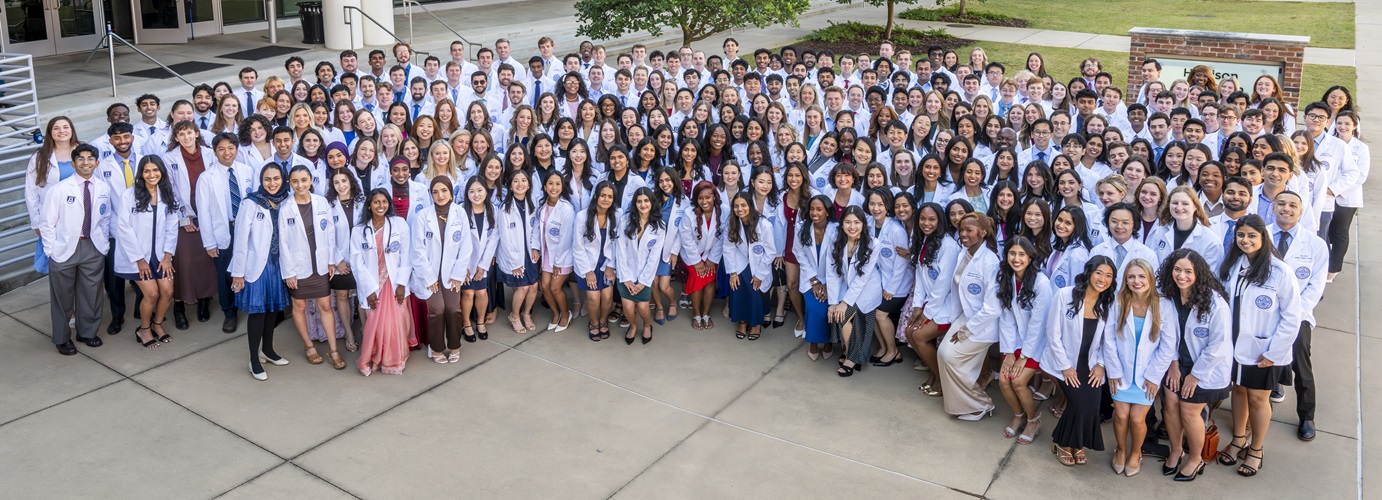
Annual Hooding Ceremony celebrates the MCG Class of 2026
Serving as dean at MCG certainly is a privilege, but few honors compare to that of watching our students grow into the physicians they’ve dreamed of becoming. Last week, we celebrated the Class of 2026 at the annual Hooding Ceremony, which is way more than a formal tradition. It marks the culmination of a journey that many of our students began decades ago, when the idea of becoming a physician first took root. This year, we had the honor of graduating 270 new MCG physicians, each one a testament to perseverance, purpose, and the support of countless families, mentors, and friends. It is a great privilege to witness their transformation throughout their medical school journey, none of which would be possible without our extraordinary faculty, whose dedication to teaching, mentoring, and modeling compassionate care shapes every one of our students.
Our amazing Academic Affairs team meticulously plans each year’s ceremony
I want to extend my heartfelt thanks to Dr. Jennifer Tucker — the best student affairs dean in the country — and the entire Academic Affairs team, whose leadership and meticulous planning ensure that every Hooding Ceremony is meaningful and deeply personal for our students and their families. A particularly poignant part of the ceremony each year is when family members have the honor of hooding their graduates. This year, it was especially moving to witness Dr. William Weston, a 91‑year‑old retired pediatrician and the namesake of one of our Department of Pediatrics student awards, hood his grandson, Dr. Weston Bush, who will soon begin his radiology residency at the University of Tennessee.
As our students leave MCG for training programs across the country, they carry with them the values and commitment to service that define this medical school. MCG has a proud tradition of producing remarkable physicians, and this ceremony is always a good reminder of our most important mission: educating the next generation. It’s an honor to celebrate them and I look forward to watching the ways they will change the world.
Hooding speaker, Dr. Paul Tran, offers sage advice to our graduates
Dr. Paul Tran, a pediatric gastroenterologist and social media influencer known to many as the person behind @ailmentaryschool on Instagram, spent several days with our students leading up to the ceremony. In his hilarious, heartfelt, and wise hooding address — one that earned a well‑deserved standing ovation from our students — he challenged our graduates to shift their thinking. Stop wondering if you’re doing good enough, he told them and start asking whether you’re doing enough good. One is about ego; the other is about the impact you have on the people around you: your colleagues, your patients, your family, and your friends.
He offered three “Paul’s Pearls,” lessons we could all stand to remember:
- Be a star — not a standout because of your accomplishments, but a North Star who guides others: patients, colleagues, and the students who will follow in your footsteps.
- Slow down — not your pace, but your posture. Don’t tower over patients when delivering news. Sit, squat, or kneel beside them. Listen without interruption. Ask “tell me more” and “what else?”
- Seek advice — acknowledge your blind spots, which we all accumulate over time. Be willing to hear the things you may not want to hear and be open to growth.
That is all certainly sage advice that I hope our graduates will carry with them in their next stage of this journey.
Dr. Puja Punukollu is the recipient of this year’s John F. Beard Award for Compassionate Care
One of the things that makes me most proud of our students is their hearts, their innate desire to make people’s lives better and, to borrow Dr. Tran’s words, to always wonder whether they’re doing enough good. That spirit is certainly true of Dr. Puja Punukollu, this year’s recipient of the prestigious John F. Beard Award for Compassionate Care.
The $40,000 award is the highest honor a health sciences graduate can earn and is given annually by Billy Payne and his wife, Martha, to a student who exemplifies compassion in health care. Payne established the award in 1998 in memory of his father‑in‑law, John F. Beard.
Dr. Punukollu has earned a reputation as an advocate for access to care and community connection
Puja has distinguished herself in many meaningful ways during her time at Augusta University. She is the first BS‑to‑MD student here to pursue an MBA alongside her medical degree, and the youngest in her cohort. She will also graduate with a Graduate Certificate in Bioethics and a Post‑Baccalaureate Certificate in Nonprofit Leadership, a combination that reflects her commitment to service, leadership, and ethical, patient‑centered care.
She also served as Miss Augusta University, becoming the first MCG student to hold that title. Her platform, Know, Go, Grow: Inspiring a Culture of Preventive Health, highlights her passion for empowering communities to take charge of their well‑being. Arriving at AU at just 17-years-old, she has grown into a strong advocate for access to care and community connection; a student leader who uses every opportunity to have the conversations that matter most. One of her nominators may have said it best: she doesn’t just deserve the Beard Award; she lives it every day.
I have no doubt Puja, who will start her family medicine residency this summer in Charlotte, will continue to be a force for good in advancing personalized, compassionate medicine.
The “Paul Brock Act” creates automated credentialing system for health care providers
In sticking with our theme of “doing the most good” today, I want to highlight an important piece of legislation that has the potential to make a real difference for Georgia’s health care workforce. This effort is the brainchild of our Northwest Campus Dean, Dr. Paul Brock, who has a no‑nonsense approach to obstacles — he fixes the situations that create them. That spirit is at the heart of the Paul Brock Act, a bill designed to streamline and modernize how health care providers are licensed and credentialed in our state.
In short, the Act directs the Georgia Composite Medical Board to upgrade its data‑management system so that physicians and other providers can enter their licensing and credentialing information once and have it accepted statewide. Facilities would still be able to add their own requirements, but the days of repeating the same paperwork over and over could finally be behind us. The goal is simple: reduce delays, eliminate redundancy, and help qualified clinicians get to work caring for patients more quickly. And isn’t that a mission we all share in?
Thank you, Dr. Brock, for your leadership in getting this across the finish line. And thank you to the Georgia General Assembly, Governor Brian Kemp, and our AU Government Relations Team for their partnership and commitment to strengthening Georgia’s health care workforce.
Dr. Amy Estes is new chair of our Department of Ophthalmology
We are incredibly fortunate at MCG to be surrounded by committed leaders, like Dr. Brock, who strengthen this institution every day. Here’s another one. Dr. Amy Estes has been named the next chair of the Department of Ophthalmology, bringing with her more than a decade of service, a steady and thoughtful leadership style, and a clear vision for where the department can grow next. She begins her new role in July.
Dr. Estes joined our faculty in 2013 and has become a central force in the department’s clinical, educational, and research missions. A respected cornea specialist, she cares for patients from across Georgia with both skill and compassion — recognition reflected in her receiving the institution’s Patient Experience Top Performer award for the past two years. She has led the Cornea Service throughout her tenure and built strong relationships with ophthalmologists statewide, strengthening MCG’s reach and reputation.
Dr. Estes has mentored countless medical students, PhD students, residents and junior colleagues
Dr. Estes has advised countless medical students pursuing ophthalmology, served on PhD committees, and played a major role in residency training — first as Associate Program Director and now as Residency Program Director. Her leadership has helped shape a residency program that is well regarded nationally, and she is committed to expanding and enhancing those educational opportunities even more. She has served in leadership roles with the Georgia Society of Ophthalmology, ultimately becoming its president, and now represents Georgia in the American Academy of Ophthalmology. She has also been a strong collaborator with the Vision Discovery Institute, contributing to multiple R01‑funded projects and 19 publications — work that continues to elevate the national visibility of MCG’s vision research.
As we welcome Dr. Estes into this new role, I also want to extend my sincere gratitude to Dr. Steve Brooks, who has served as chair since 2020 and will now return to his faculty role as a pediatric ophthalmologist. Dr. Brooks has guided the department through years of transition with steadiness, kindness, and a deep commitment to our learners and patients. I’m thankful that he will continue to share his expertise with our students, residents, and the children and families he serves, and that he will continue his important work in patient care, research, and education.
MCG Standardized Patient Program earns prestigious accreditation
As we close today, I want to share one more tremendous point of pride for MCG — and truly for all of Augusta University. Our Standardized Patient program has been awarded full accreditation in human simulation by the Association of Standardized Patient Educators (ASPE), a distinction held by only 19 programs nationwide at the time of our application. This recognition is especially meaningful because ASPE focuses exclusively on the quality and outcomes of these programs. It affirms what we have long known: that our Standardized Patient Program is exceptional in every way, from case development to performance assessment, and that our standardized patients play an irreplaceable role in shaping the clinical skills of not just medical students, but every health professions learner at this university.
This milestone also reflects the strength of our SPEAR Center, led by the remarkable Dr. AJ Kleinheksel, our Assistant Dean for Educational Simulation. It was her vision to bring the operations, education, and research and evaluation units of our simulation enterprise under one unified umbrella — the SPEAR Center, short for Simulated Patients for Education, Assessment & Research. That alignment has created a streamlined and effective model that ensures high‑quality simulation experiences are accessible to every learner who needs them.
I also want to thank our Standardized Patient Program Director, Dr. Edward Agabin, and the entire program team. The SPEAR Center and this accreditation are powerful examples of the collaborative culture that defines this medical school and this university. Congratulations on this well-deserved recognition.
My best to you all,

David C. Hess, MD
Dean, Medical College of Georgia
Upcoming Events
May 21 – MCG Faculty Awards Ceremony, 5 p.m., Natalie and Lansing B. Lee Jr. Auditorium
June 26 – MCG Faculty Senate Meeting, noon, Natalie and Lansing B. Lee Jr. Auditorium